

The AI learning journey has become one of the most consequential professional investments of this decade. For seasoned leaders and practitioners, the question is rarely about motivation — it’s about finding a structured path that respects both the depth of their existing expertise and the genuine complexity of what AI demands.
What separates those who build lasting AI capability from those who don’t isn’t access to resources. It’s the presence of a deliberate, well-sequenced framework – one that compounds over time rather than overwhelms from the start.
Table of Contents
- Phase 1 of Your AI Learning Journey — Start With an Honest Assessment
- Phase 2 — Build the Right Foundation for Your AI Learning Journey
- Phase 3 — Choose How to Move Forward on Your AI Learning Journey
- Phase 4 — Doing Is the Best Part of Any AI Learning Journey
- Phase 5 — Sustaining Your AI Learning Journey Long-Term
- FAQs
- Conclusion
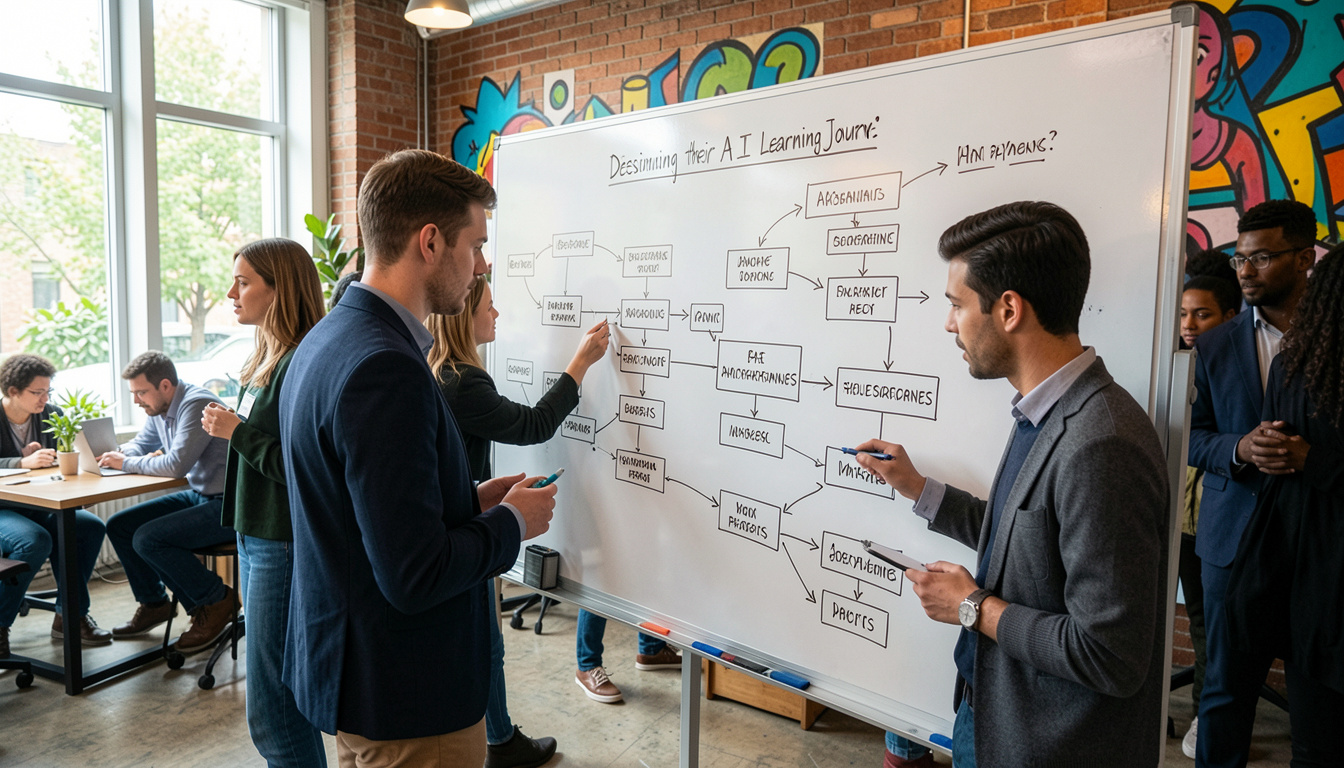
Phase 1 of Your AI Learning Journey — Start With an Honest Assessment
Every effective AI learning journey begins with calibration. Understanding where one’s current knowledge sits — not in relation to a generic benchmark, but in relation to the specific demands of one’s role and industry — is what determines the quality of everything that follows.
The alignment between learning goals and professional context matters enormously here. A chief people officer building AI literacy for workforce planning needs a fundamentally different path than a supply chain head exploring automation. The more precisely the goal is defined, the more efficient and sustainable the journey becomes.
Phase 2— Build the Right Foundation for Your AI Learning Journey
Before engaging with tools and platforms, a working understanding of how AI actually functions — even at a conceptual level — makes the entire learning experience more coherent and transferable.
Language models, the engines behind most generative AI tools today, process input by breaking text into units called tokens — roughly equivalent to a word or fragment of one. This seemingly small detail has significant practical implications: it explains why precise, well-structured inputs consistently produce better outputs, and why context tends to degrade in very long exchanges. For professionals whose work depends on communication and precision, this is immediately relevant.
The architectural leap that made all of this possible was the Transformer, introduced in 2017. Prior to this, language models processed information sequentially – word by word, with limited contextual reach. The Transformer changed that entirely, enabling models to process entire inputs at once and understand relationships across them. Every major AI tool in use today — Claude, GPT-4, and Gemini — is built on a variation of this architecture. Understanding this isn’t a technical exercise; it’s context that sharpens judgement about what these tools can realistically do.
It also helps to situate today’s AI within its broader evolution. The field has moved through distinct stages — from Narrow AI designed for single tasks, through Machine Learning and Deep Learning, into Natural Language Processing and the Generative AI tools now in mainstream use. Knowing where current tools sit in that arc makes the landscape far less overwhelming and far more navigable.

Phase 3 — Choose How to Move Forward on Your AI Learning Journey
Platforms offering structured pathways for AI skill development have expanded significantly — Coursera, LinkedIn Learning, Google’s Generative AI Learning Path, and fast.ai among them. For a broader look at how AI is reshaping the people function specifically, this piece on AI in HR & L&D covers what workforce leaders are actually prioritising right nowThe more useful question isn’t which platform has the most content, but which progression matches the learner’s current foundation and professional objectives.
AI-enhanced learning has also emerged as a powerful approach in its own right — using AI tools themselves as active components of the learning process. Rather than passive consumption, this means engaging tools like Claude or ChatGPT to stress-test understanding, explore edge cases, translate concepts into industry-specific scenarios, and generate meaningful practice. The quality of that engagement depends entirely on the quality of thinking brought to it.
Phase 4 — Doing Is the Best Part of Any AI Learning Journey
The ability to feed AI well-structured, contextually rich inputs — commonly referred to as prompting — is one of the most immediately transferable skills in the entire learning journey. It is, at its core, a discipline of clarity: the more precisely a need is articulated, the more useful the output.
There is a useful analogy in professional cooking. Have you ever saw a skilled chef following a recipe? They understand the principles behind it, which allows them to adapt, improvise, and consistently produce quality regardless of what changes. AI literacy works similarly. Familiarity with a tool produces results; understanding the underlying logic produces capability — and capability is what lasts.
Phase 5 — Sustaining Your AI Learning Journey Long-Term
The fundamentals of AI — how models are trained, how to evaluate their outputs critically, how to prompt with precision — evolve far more slowly than the tools built on top of them. A learning approach anchored in principles rather than specific products holds its value far longer.
For organisations, the stakes of a well-designed AI learning journey extend beyond individual capability. When learning is fragmented — different tools, different vendors, no common thread — the investment rarely compounds. Platforms like Huksa, Infollion’s Managed Training Services offering, are built precisely for this: serving as an embedded L&D partner that designs and delivers cohesive, role-specific AI learning journeys for enterprise teams, from skill assessment through to measurable outcomes.

FAQs
What are the four steps in an AI learning journey?
A well-structured AI learning journey tends to move through four broad stages — building foundational literacy, developing working knowledge of core concepts and tools, applying that knowledge through real projects, and eventually deepening expertise in areas most relevant to one’s role. In practice, these stages rarely follow a straight line; most learners find themselves cycling back and building forward at the same time.
What is the breakthrough technology that powers modern AI?
The Transformer architecture, introduced in 2017, is what made modern AI language models possible. Before it, models worked through language sequentially — word by word, with limited sense of what came before or after. The Transformer changed that by allowing models to take in an entire input at once, which is what gives today’s tools — Claude, GPT-4, Gemini — their ability to hold context and respond with coherence.
What is a token in AI language?
A token is the basic unit an AI language model uses to read and generate text — somewhere between a syllable and a word, depending on the model. It is a small concept with practical weight: token limits shape how much a model can process in one exchange, and an awareness of how models parse input goes a long way in understanding why some prompts land better than others.
How to use AI as a learning tool?
AI tools become genuinely useful for learning when the engagement is active rather than passive. Asking a model to explain something differently, push back on an assumption, or apply a concept to a specific industry scenario produces far more than simply reading what it generates unprompted. The learner who brings a question gets an answer; the one who brings a perspective gets a conversation.
Conclusion
The AI learning journey is not a race to any particular finish line — it is a progressive accumulation of understanding, applied consistently over time. Those who build lasting capability in this space tend not to be the earliest adopters or the most prolific consumers of content. They are the ones who approached it with structure, connected it to the realities of their work, and stayed the course past the initial novelty. The tools will continue to evolve. The models will grow more capable. A well-designed AI learning journey builds something no tool update can obsolete — the clarity to know what to trust, the confidence to act on it, and the range to keep pace with whatever the next wave brings.