
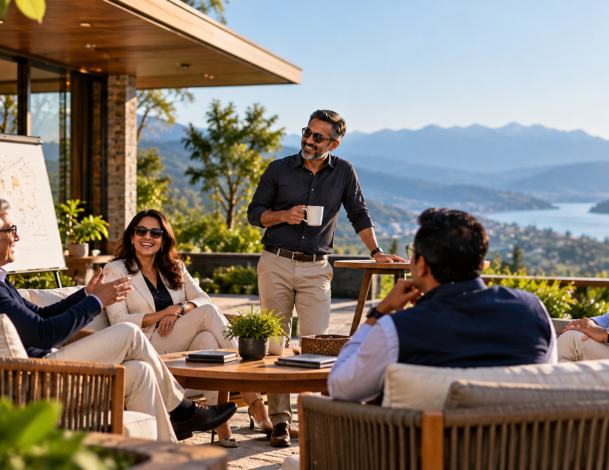
Senior leaders often plan strategy in the same rooms where they run daily operations. Leadership retreats gives CXOs and decision-makers a different setting for that work: a private venue, a small group, a senior industry voice and time to think without interruptions. Done well, it ends with a clear strategy outlook and an owner for every priority. This blog covers what leadership retreats can do for your team, how to design one for strategy building, a sample agenda, how to choose a location and a planner, and how Huksa approaches strategy-led retreats.

What Can a Leadership Retreat Do for Your Leadership Team?
A leadership retreat gives a senior team what daily work rarely allows: uninterrupted time together, new input and room to think.
- Time together: your senior leaders in one place, away from the pull of daily operations
- Fresh perspective: a senior industry voice shares how similar decisions played out elsewhere
- New ideas: unfamiliar experiences raise questions that a boardroom rarely does
- Stronger trust: shared experiences help leaders see colleagues in a new light
- Clear direction: the group leaves with priorities, owners and a one-page outlook
These benefits build on each other, which is why the order of the retreat matters.
What Does a Leadership Retreat Look Like from the Inside?
A two-day leadership retreat moves from input to reflection to decisions. Each part has a clear purpose.
- Arrival and context setting: an unhurried start at a private venue, with a short conversation on the question the team wants to work on
- Closed-door industry session: a senior guest shares experience, and leaders ask direct questions in a small room
- An experience outside work: a new activity for everyone, where titles matter less and leaders see how colleagues think on their feet
- Private dinner: an informal evening where conversation often returns to the business without an agenda
- Facilitated strategy session: ideas shaped by the guest session and the shared experience become three to five priorities
- Outlook and commitments: each priority gets an owner and a timeline before the group leaves
How Can a Leadership Retreat Be Designed for Strategy Building?
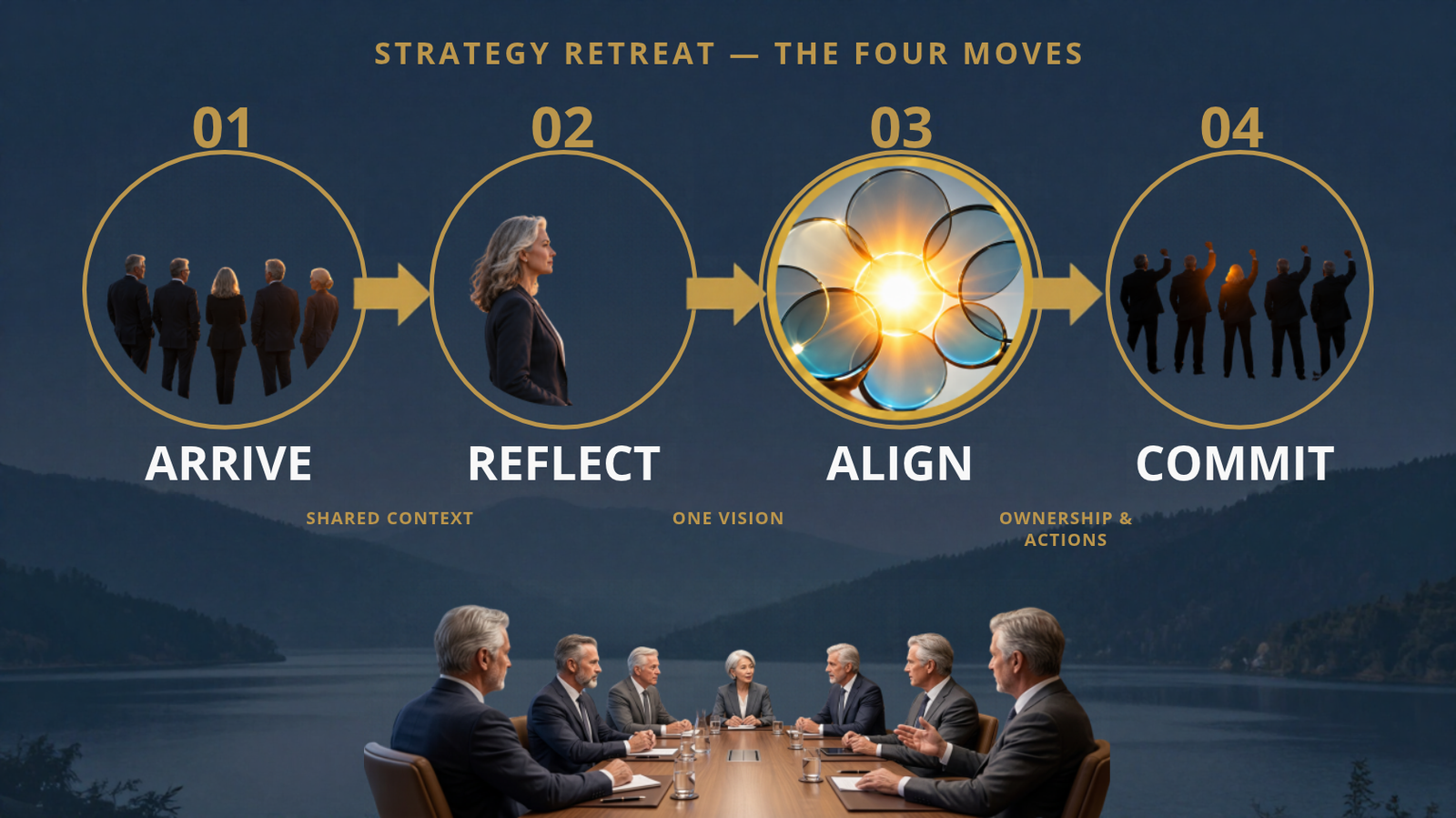
A strategy-led retreat works best as a sequence in which each part prepares the group for the next: a defined question, industry context, an experience outside work, guided reflection and a strategy outlook.
Step 1: Define the Strategic Question
Choose one question for the group to work on, and share it early so leaders arrive with thoughts.
- Examples: entering a new market, restructuring, a three-year growth plan, responding to a shift in the industry
- Agree on the outcomes expected at the end
- Send a short pre-read ahead of the retreat
Step 2: Bring in Industry Context
Invite a senior industry voice to exchange ideas with the group. A leader who has been through a similar decision brings what no report can: how it felt and what they would do differently.
- Keep it closed-door so the guest can speak openly
- Choose someone who is not a direct competitor
- Share the strategic question with the guest in advance
- Ask each leader to bring two or three questions
- Plan 90 to 120 minutes, and leave time afterwards for informal conversation
Step 3: Add an Experience Outside Work
Give the group something unfamiliar and unrelated to work. An outdoor adventure, a new sport or a hands-on task in nature can all work. The aim is to take people out of their expert role and see what they do.
- Match the activity to the group’s fitness, the season and the location
- Keep it beginner friendly, with certified instructors and a safety briefing
- Choose activities that bring the group together instead of setting leaders against each other
- Keep the schedule loose around it. Some of the best conversations happen over a meal afterwards
Step 4: Reflect and Brainstorm
Hold the discussion soon after the experience, while the group is relaxed and open. A neutral facilitator guides it so every voice gets space.
- Ask what the group noticed about how it worked together
- Link those observations to how the business is led
- Start with silent idea writing, then move to small group rounds
- Rank ideas by impact and effort
Step 5: Build the Strategy Outlook
Turn the ideas into three to five priorities. Give each one an owner and a timeline. Produce a one-page outlook before the group leaves, and plan a 30-60-90 day follow-up.
Sample 2-Day Leadership Retreat Agenda
Time | Session | Purpose |
Day 1 | ||
Morning | Arrival and context setting | Share the strategic question |
Late morning | Closed-door session with a senior industry guest | Gain outside perspective |
Afternoon | Experience outside work | Step out of routine roles |
Evening | Private dinner | Open conversation, no agenda |
Day 2 | ||
Morning | Guided reflection and brainstorming | Link the experience to strategy |
Late morning | Strategy development | Set priorities, owners and timelines |
Afternoon | Outlook and commitments | Agree on the one-page outlook |
What Do Leaders Take Back from a Leadership Retreat?
Leaders return with more than notes. They bring a shared experience and a plan the leadership group helped shape.
- A one-page strategy outlook with three to five priorities
- An owner and a timeline for each priority
- A shared language from the guest session and the experience
- Stronger working relationships across the leadership team
- A 30-60-90 day follow-up to keep the momentum going

How to Choose a Location for a Leadership Retreat
The location sets the tone. Choose one that is easy to reach, private and able to support both the discussion and the experience. For leadership retreats from Delhi NCR, a short flight or drive keeps travel from eating into the agenda.
- Check travel time from Delhi NCR and other metros
- Look for private venues with reliable connectivity and space for closed-door sessions
- Choose properties with a small guest count, so the group has the place to itself
- Make sure the surroundings allow the outdoor experience you plan
- Compare workation-friendly venues with resort-style stays. Workations suit longer visits, while resorts suit short, focused retreats
- Verify operator certification and insurance for every activity
What Should Leadership Retreat Packages Include?
Corporate offsite packages usually stop at stay, meals, transport and a set of team-building activities. A leadership retreat package goes further. It covers the thinking that shapes the days.
- A private venue and thoughtful hospitality
- A senior guest session
- An experience outside work, with certified instructors
- A trained facilitator for reflection and strategy sessions
- A one-page outlook and a 30-60-90 day follow-up
Plan ahead and consider off-season dates. They often bring better rates and better availability at the venues worth choosing.
Top Leadership Retreat Planners and Organizers in India
Look for a planner who can shape the content of the retreat as well as manage the venue. Before you hire, ask:
- Have they run CXO-level leadership retreats?
- Can they source senior guest speakers?
- Do they offer facilitation along with logistics?
Event management agencies in Delhi NCR are strong on venues and logistics. For a strategy-led retreat, check how much content design they offer.
Planner type | Strengths | Best for |
Logistics-led event agencies | Venues, travel, vendor handling | Large team events and celebrations |
Travel and resort companies | Stay packages, activities | Team trips and workations |
Huksa | Practitioner-led sessions, facilitation, sector depth | CXO and leadership retreats built around strategy |
How Does Huksa Design Leadership Retreats?
Huksa builds leadership retreats the way it builds learning programs: around the people and the problem. No two retreats look alike. A team facing a supply shift in automotive has different questions from a BFSI team planning expansion, and the retreat reflects that.
- Practitioner-led sessions with people who know your sector
- Experiences chosen for the group, to bring out how its leaders think and act
- Facilitated reflection that links each experience to strategy
- Sector depth across Automotive, Manufacturing, Pharma and BFSI
- A 30-60-90 day follow-up to review progress
To see what a retreat could look like for your team, talk to Huksa.
Conclusion
A good leadership retreat gives a team new input, a change of pace and a clear route from ideas to decisions. Start with one strategic question, bring in an outside view, add an unfamiliar experience, reflect with a facilitator and close with a one-page outlook. If you want a partner to design this around your leadership team, plan your next CXO retreat with Huksa.

FAQs
What is the difference between a leadership retreat and team building?
A leadership retreat is a planned programme with a business goal, such as strategy or planning. Team building focuses on how people work together. A leadership retreat can include team-building activities, but its main output is a set of decisions.
How long should a leadership retreat be?
Two days and one night works for a single strategic question. If the agenda covers a multi-year plan or several business units, extend it to three days so the discussion and outlook have room.
How many people should attend a CXO retreat?
Between 8 and 15 people works well. The group stays small enough for every leader to speak and large enough to bring different functions into the discussion.
What is a workation and can it work for leadership teams?
A workation combines work with a stay in a leisure destination. It can work for leadership teams when the schedule is structured and the venue has reliable connectivity. For strategy sessions, a clear agenda matters more than the location type.
How do I measure the ROI of a leadership retreat?
Track outcomes against the strategic question. Count the priorities agreed, the owners assigned and the progress at 30, 60 and 90 days. Compare these with the goals set before the retreat.
How far in advance should we plan a leadership retreat?
Plan four to eight weeks ahead for a two-day retreat. Allow more time if you want a senior industry guest, since their calendars fill early.