
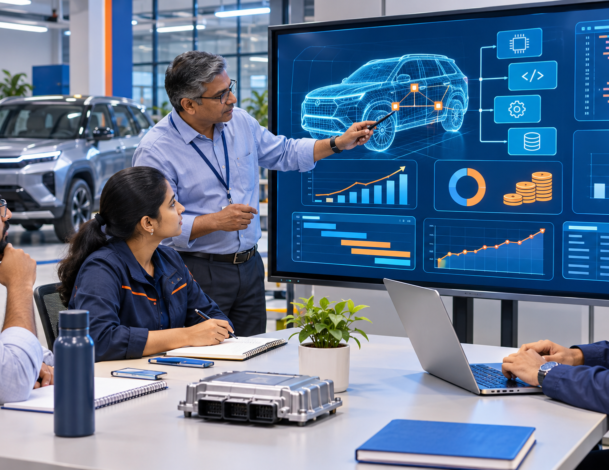
Advances in vehicle electronics, software-defined architectures, advanced driver assistance systems (ADAS), alternative powertrains and connected technologies are changing how vehicles are engineered. They are also influencing how automotive components are designed, manufactured, validated, costed and integrated into increasingly complex vehicle systems.
We will be discussing about Automotive L&D trends for India’s automotive component manufacturers, this evolution introduces new dimensions of technical and commercial complexity.
Traditional priorities such as dimensional accuracy, tooling reliability, process capability, defect prevention and supplier quality remain essential. However, they increasingly intersect with requirements involving electronic interfaces, system-level validation, advanced materials, software development and cost competitiveness.
Recent technical capability initiatives by Mahindra & Mahindra, Tata Motors, General Motors and Toyota Kirloskar Motor offer useful insights into how the industry is responding.
Although these initiatives address different audiences and technologies, they reveal a common direction: automotive capability development is becoming more specialised, multidisciplinary and closely connected to practical engineering requirements.
For component manufacturers, understanding these shifts can help identify where technical expertise is becoming more valuable.

What Are Automotive Manufacturers Prioritising in Technical Capability Development?
Across major automotive manufacturers, investments in workforce capabilities increasingly reflect the technologies, engineering challenges and operational requirements shaping future vehicle programs.
Four examples illustrate this transition.
Mahindra & Mahindra: Developing Expertise for Complex Vehicle Architectures
In its FY2025–26 Integrated Annual Report, Mahindra & Mahindra highlighted technical capability development across ADAS, software-defined vehicles, connected cars, cybersecurity, electric powertrains and advanced vehicle systems.
At Mahindra Research Valley, teams have also developed expertise in areas including electric powertrain calibration, vehicle diagnostics, ADAS validation, vehicle dynamics and software evaluation.
The company’s Mahindra Technical Academy delivered more than 200 learning programs covering technical and behavioural competencies.
Source: Mahindra & Mahindra Integrated Annual Report 2025–26
These initiatives reflect the growing integration of mechanical, electrical, electronic and software systems within modern vehicles.
For component suppliers, the implication is particularly relevant where products interact with multiple vehicle systems. Suppliers of sensors, electronic modules, powertrain components and safety-critical assemblies may need more sophisticated knowledge of system interfaces, functional requirements and validation methods.
The broader shift is from isolated component expertise towards a more integrated understanding of vehicle performance.
Tata Motors: Combining Advanced Engineering with Manufacturing Fundamentals
Tata Motors has also emphasised technical capability development for emerging automotive technologies.
Its FY2025–26 reporting describes development initiatives involving software-defined vehicles, cybersecurity, Automotive SPICE (ASPICE), functional safety, ADAS, high-voltage architecture and AI-assisted product development.
Source: Tata Motors FY2025–26 Annual Report
At the manufacturing level, foundational disciplines remain equally important. The company’s workforce-development initiatives have included safety, Total Quality Management (TQM), problem-solving and Kaizen.
Source: Autocar Professional, May 2026
These developments highlight an important distinction: technological advancement does not replace manufacturing fundamentals. It increases the importance of applying them in more complex engineering environments.
As software becomes more integral to vehicle functionality, related competencies in software estimation, engineering project planning and technical procurement also become relevant.
For component manufacturers, the challenge is to combine product and process expertise with an understanding of emerging technologies, development effort and commercial implications.
General Motors: Reinforcing Practical Diagnostics and Skilled Technical Work
In May 2026, General Motors reported investing nearly US$200 million over the preceding year in initiatives to grow and modernise skilled-trades careers in the United States.
Its workforce-development initiatives include apprenticeships, technician development and practical learning involving electronics, diagnostics and electric vehicle systems.
Source: General Motors, May 6, 2026
Diagnosing a modern vehicle-related issue can require considerably more than examining an individual component. Engineers and technicians may need to interpret sensor signals, assess electronic interfaces, analyse diagnostic data and distinguish component failures from system-level issues.
For automotive suppliers producing electronic and mechatronic assemblies, comparable diagnostic capabilities can improve failure investigation, validation and product quality.
GM’s approach illustrates the continuing relevance of practical technical learning, where experience in applying knowledge is as important as understanding the underlying concepts.
Toyota Kirloskar Motor: Strengthening Industry-Ready Technical Foundations
Toyota Kirloskar Motor offers another perspective through its investment in industry-linked technical education.
In May 2026, the company announced a Toyota Technical Education Program (T-TEP) centre at Siliguri Institute of Technology in West Bengal, with an annual intake capacity of 180 students.
The initiative combines technical education, workplace readiness and practical exposure through on-the-job training at authorised Toyota dealerships.
Source: Toyota Kirloskar Motor, May 26, 2026
Unlike internal engineering development initiatives, Toyota’s program primarily strengthens the external automotive talent pipeline.
Nevertheless, it reinforces a principle relevant across manufacturing: technical knowledge must be supported by workplace discipline, structured practical exposure and strong operational fundamentals.
For component manufacturers, these capabilities continue to influence production consistency, quality ownership and shop-floor problem-solving.

What Do These Developments Mean for Automotive Component Manufacturers?
The four examples do not suggest that every supplier requires identical competencies.
Instead, they demonstrate how automotive expertise is evolving across different technical functions.
For auto-component manufacturers, the implications become clearer when examined through specific engineering, manufacturing, quality and commercial challenges.
1. Product Design and Validation Are Becoming More System-Oriented
Component engineering traditionally involves balancing material selection, functional performance, dimensional tolerances, manufacturability, durability and cost.
These considerations remain essential, but modern vehicle architectures introduce additional integration requirements.
A sensor housing, mounting assembly or powertrain component may meet its individual dimensional specifications while still presenting difficulties during vehicle-level integration.
Potential concerns include vibration behaviour, thermal performance, electrical interfaces, material compatibility and operating conditions.
This increases the relevance of capabilities such as Geometric Dimensioning and Tolerancing (GD&T), Design Failure Mode and Effects Analysis (DFMEA), design validation, material selection and system-level failure analysis.
The challenge is no longer limited to designing a component that meets specifications. It also involves understanding how that component performs within the complete vehicle system.
2. Tooling Precision and Process Stability Remain Critical
For suppliers of stamped, machined, moulded and fabricated components, recurring challenges can include tool wear, dimensional variation, process drift, setup inconsistencies and rejection rates.
Consider a stamping operation experiencing repeated dimensional deviations.
Resolving the issue may require examining die alignment, tooling condition, material behaviour, process parameters and measurement-system reliability.
Without adequate technical understanding, corrective actions may produce temporary improvements rather than sustainable process control.
Capabilities in tooling development, Statistical Process Control (SPC), Measurement System Analysis (MSA), process capability analysis and structured root cause investigation therefore remain highly relevant.
3. Automotive Quality Requires Stronger Risk Prevention
For suppliers working with automotive manufacturers, quality planning and production approval are critical operational responsibilities.
Frameworks including Advanced Product Quality Planning (APQP), Failure Mode and Effects Analysis (FMEA), control plans, MSA, SPC and Production Part Approval Process (PPAP) provide structure for managing product and process quality.
However, their effectiveness depends on practical implementation.
A completed PPAP submission does not automatically establish stable production. Similarly, a Process Failure Mode and Effects Analysis (PFMEA) has limited value if identified risks are not reflected in actual process controls.
Consider a new component launch where initial samples meet specifications but production trials reveal unstable process capability.
The underlying issue could involve incomplete process validation, insufficient control planning or weak coordination between engineering and manufacturing teams.
Practical expertise in launch readiness, preventive quality planning and failure analysis can help suppliers identify and address these risks earlier.
4. Electronics and Mechatronics Demand Better Diagnostic Capabilities
As vehicles incorporate more electronic control systems, component-related fault investigation becomes increasingly complex.
For suppliers working with sensors, actuators, wiring systems and electronic control units, understanding electrical and electronic interfaces is essential.
An intermittent sensor fault could originate from the component, wiring, connector reliability, electrical interference or control-system interactions.
Determining the cause may require interpreting signals, studying operating conditions and following structured diagnostic procedures.
Relevant technical competencies may include sensor and actuator fundamentals, Controller Area Network (CAN) communication, electronic diagnostics, failure analysis and system validation.
In safety-critical applications, additional knowledge of functional safety requirements may also be necessary.
5. Cost Estimation Is Becoming a More Strategic Engineering Capability
As automotive products become more complex, cost estimation increasingly requires a detailed understanding of technology, software development and manufacturing economics.
For component manufacturers, product costing is influenced by material selection, manufacturing processes, tooling investments, production volumes, quality requirements and engineering complexity.
A technically feasible component design may not necessarily be commercially optimal.
For example, changing a material specification or manufacturing process can affect tooling requirements, production yield, machining time and overall component cost.
This makes cost modelling, value engineering and manufacturing cost analysis relevant across product development, sourcing, procurement and commercial engineering.
Software-intensive automotive systems introduce another dimension.
As vehicle software becomes more sophisticated, engineering teams may need structured methods to estimate software size, development effort, timelines and associated costs.
One such method is IFPUG Function Point Analysis, which provides a standardised approach to measuring software functional size based on user requirements.
Alongside function point analysis, the Software Non-functional Assessment Process (SNAP) provides a complementary approach to sizing non-functional software requirements.
These methodologies can support more consistent software project estimation and planning when combined with relevant productivity data, cost assumptions and project-specific considerations.
Source: International Function Point Users Group
For automotive manufacturers and software-intensive component suppliers, such capabilities can strengthen software procurement evaluation, project budgeting and engineering cost management.
While manufacturing cost estimation and software cost estimation address different challenges, both highlight a broader industry requirement: engineering decisions increasingly need to account for technical performance and commercial feasibility together.
6. Manufacturing Data Is Becoming More Valuable When Combined with Domain Expertise
Digital technologies and AI can create opportunities to improve manufacturing visibility, identify recurring defects and support operational decisions.
However, the value of analytics depends on data quality and the ability to interpret results within the manufacturing context.
A production dashboard may reveal rising rejection rates or unusual machine-parameter patterns. Identifying the actual cause still requires knowledge of the equipment, process, materials and inspection methods.
Potential applications include scrap analysis, process capability monitoring, predictive maintenance and production-performance improvement.
The opportunity is to combine data literacy with practical manufacturing knowledge rather than treating analytics as an isolated technology initiative.
Which Technical Capabilities Should Auto-Component Manufacturers Prioritise?
Capability priorities vary according to component category, manufacturing technology, customer requirements and workforce responsibilities.
Component category | Common challenges | Relevant technical capabilities |
Precision metal and stamped components | Dimensional variation, tool wear, process instability | Tooling, GD&T, PFMEA, SPC, MSA, PPAP |
Electronics and mechatronics | Sensor reliability, diagnostics, integration | Electronic diagnostics, system validation, failure analysis |
EV powertrain and battery-related components | Thermal behaviour, electrical interfaces, safety | EV systems, material validation, risk analysis |
Rubber, polymer and sealing components | Durability, material performance, dimensional stability | Material engineering, testing, process control |
Machined and fabricated assemblies | Tolerance control, manufacturing cost, repeatability | Manufacturing engineering, cost modelling, metrology |
Automotive software and embedded systems | Software complexity, development effort, cost predictability | Software cost estimation, IFPUG, SNAP, project sizing |
Supplier quality and new product development | Launch delays, process risks, customer approval | APQP, PPAP, PFMEA, control plans, validation |
These priorities are illustrative. Actual requirements depend on a supplier’s product portfolio, engineering responsibilities and operating environment.

How Can Automotive Suppliers Make Smarter Capability-Development Decisions?
Effective capability development begins with the technical and operational challenges already present within an organisation.
Three considerations can help make these decisions more precise.
Identify the underlying problem. A recurring quality rejection, delayed PPAP approval, high manufacturing cost, inconsistent tool performance or difficulty estimating software development effort each points towards a different technical competency.
Identify the functions responsible for the outcome. Design engineers, cost engineers, quality professionals, procurement teams, manufacturing engineers and maintenance personnel contribute at different stages of the product lifecycle.
Connect learning with practical application. Component drawings, manufacturing cost breakdowns, process data, PFMEA exercises, diagnostic simulations and engineering case studies help professionals apply new concepts to their work.
For example, a manufacturing cost-estimation program becomes more useful when participants examine actual cost drivers such as material consumption, machine-hour rates, tooling amortisation, rejection allowances and production volumes.
Similarly, IFPUG-based software costing becomes more practical through exercises involving functional requirements, function point measurement, productivity assumptions and software project scenarios.
The objective is not simply to increase the volume of training. It is to develop expertise that enables better technical decisions, more reliable processes and informed commercial judgments.
Building Deep-Domain Automotive Capabilities with HUKSA by Infollion
As automotive manufacturing becomes more specialised, capability development must move beyond generic technical awareness.
The requirements of a product design engineer working on vehicle durability differ considerably from those of a quality professional managing PFMEA, a manufacturing engineer responsible for process capability, or a cost engineer evaluating software-development expenditure.
Each role demands specialised technical knowledge, an understanding of industry practices and the ability to apply concepts in real engineering environments.
HUKSA by Infollion, the corporate learning and capability-development business of Infollion Research Services Ltd., addresses these requirements through practitioner-led technical programs designed around specific industry challenges.
Backed by Infollion’s network of over one lakh industry practitioners, HUKSA connects organisations with experienced engineers, industry specialists, technical consultants and functional experts who bring practical experience into capability development.
Our Automotive Technical Expertise
HUKSA’s technical learning portfolio spans multiple areas of automotive engineering and component manufacturing.
Automotive Quality and Process Excellence
Programs covering APQP, PPAP, DFMEA, PFMEA, control plans, MSA, SPC, root cause analysis and automotive quality systems help engineering and quality teams develop a more integrated understanding of risk prevention, production readiness and process control.
The focus is not limited to understanding individual methodologies. Programs can examine their application through manufacturing scenarios, quality documentation, failure investigations and process-improvement exercises.
For example, PFMEA interventions can include analysing actual process risks, reviewing existing control measures and connecting identified failures with practical preventive actions.
Manufacturing Engineering, Tooling and Product Development
Technical programs can address tooling development, dimensional engineering, manufacturing-process optimisation, design validation, component performance and engineering problem-solving.
These capabilities are particularly relevant to teams responsible for tooling reliability, product development, manufacturing quality and the introduction of new components.
Learning interventions can be adapted to specific component categories and production technologies, allowing participants to work through engineering challenges relevant to their operations.
Vehicle Engineering and Specialised Validation
HUKSA’s automotive expertise also extends into specialised technical areas such as vehicle corrosion validation, durability engineering, product performance and vehicle premiumness assessment.
These domains require more than general automotive knowledge. They demand a detailed understanding of component behaviour, testing methodologies, validation criteria and the relationship between engineering decisions and vehicle-level performance.
Specialist-led learning helps connect technical principles with the engineering practices used across the automotive product-development lifecycle.
Software Engineering, Cost Estimation and Digital Technologies
As software becomes increasingly central to vehicle functionality, cost engineering and software procurement teams require methods to assess software size, effort and development economics.
HUKSA supports specialised capability development in software measurement, estimation methodologies, cost engineering and related digital technologies.
Our work with Tata Motors provides a practical example of how such interventions can be structured for a specific automotive engineering requirement.
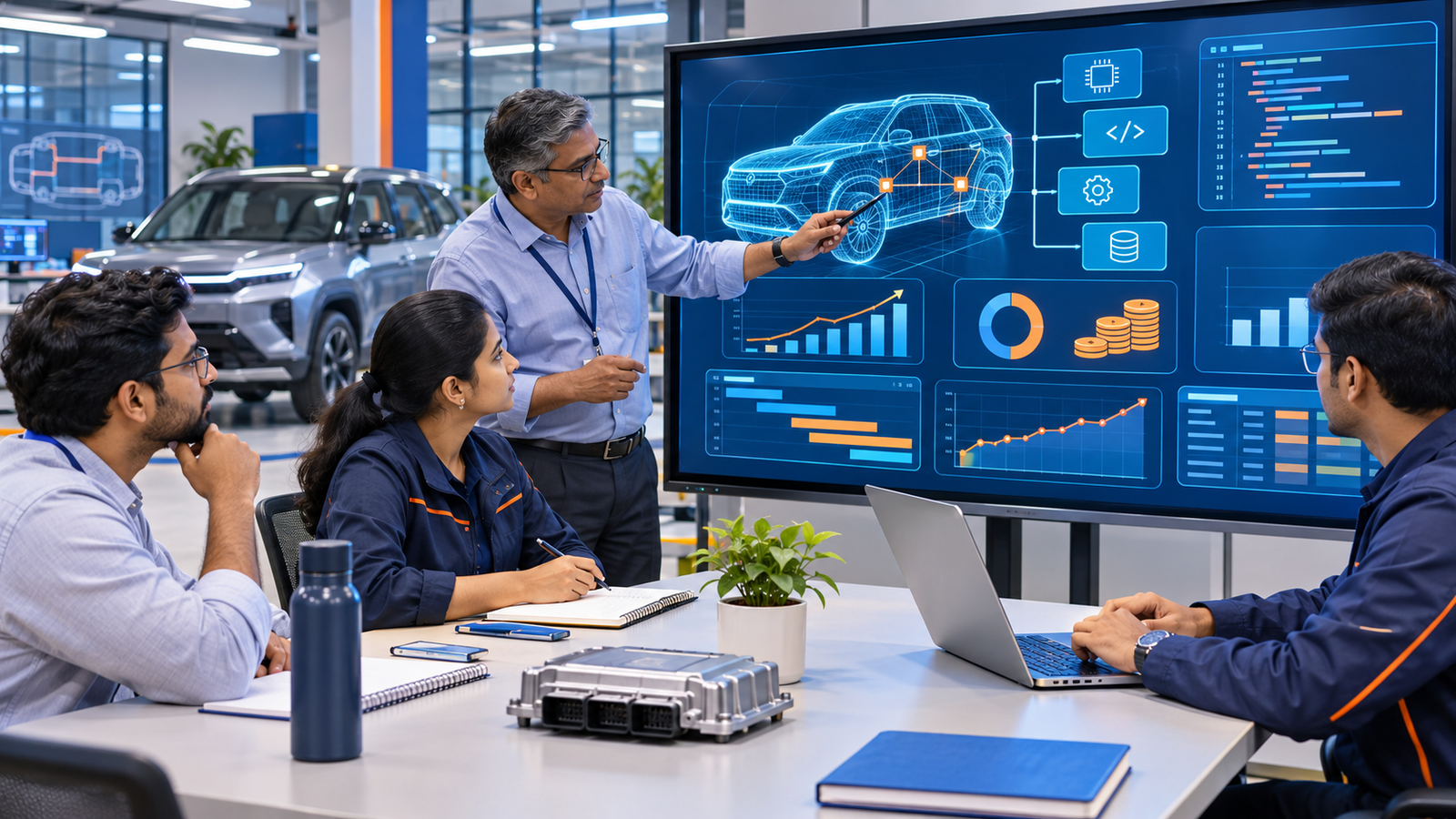
HUKSA in Practice: Software Cost Estimation for Tata Motors
HUKSA delivered a two-day onsite Software Cost Estimation workshop for Tata Motors in Pune, designed to strengthen and standardise software cost-estimation practices.
The program was conducted for professionals from the company’s cost engineering and software procurement functions, addressing the need for structured methodologies to evaluate software requirements, estimate project size and support more consistent costing practices.
The workshop covered two specialised methodologies:
IFPUG Function Point Analysis (FPA) — A structured approach to measuring the functional size of software applications based on user requirements. The methodology provides a standardised measurement basis that can support software effort and cost estimation.
Software Non-functional Assessment Process (SNAP) — A complementary sizing methodology for non-functional software requirements, providing additional visibility into dimensions of software work not captured through functional size alone.
Beyond the methodologies themselves, the intervention covered practical aspects of software cost engineering, including:
- Functional and non-functional requirement assessment.
- Software project and application sizing.
- Productivity measurement for development teams.
- Software estimation templates and cost sheets.
- Project effort estimation and standardised costing practices.
- Preparation for applying IFPUG and SNAP measurement standards.
The workshop was facilitated by a certified IFPUG and function point analysis specialist with over 20 years of experience across the IT, automotive and telecommunications sectors.
The expert brought experience in software project sizing, estimation studies, productivity analysis and program cost management, helping connect formal measurement methodologies with practical software costing requirements.
The program also aimed to prepare participants for future IFPUG and SNAP certification pathways.
This engagement illustrates how specialised capability development can address a technical requirement that sits at the intersection of automotive engineering, software development, procurement and financial planning.
Rather than approaching software costing as a generic financial exercise, the program focused on structured measurement methods and the technical understanding required to apply them consistently.
Read the full workshop showcase: Tata Motors | Software Cost Estimation
From Technical Knowledge to Practical Application
Across these domains, HUKSA’s approach centres on connecting the right practitioner expertise with the specific challenges of the organisation.
Depending on the requirement, programs can incorporate real-world engineering cases, technical exercises, manufacturing scenarios, assessments, project-based assignments and implementation-oriented learning.
For component manufacturers, this could involve applying PFMEA to an existing production process, examining dimensional variation in a tooling operation, evaluating product-validation requirements or working through software-estimation exercises using structured measurement frameworks.
The emphasis remains on developing technical capabilities that professionals can apply within their own engineering and manufacturing responsibilities.
Explore relevant HUKSA programs:
The Road Ahead
The initiatives of Mahindra, Tata Motors, General Motors and Toyota demonstrate how automotive capability requirements are evolving across advanced technologies, manufacturing fundamentals and practical engineering.
For auto-component manufacturers, the priority is not simply adopting every emerging technology. It is strengthening the specific engineering, quality, manufacturing and cost capabilities most relevant to their products and processes.
As automotive systems become more complex, combining deep technical expertise with practical application and commercial understanding will remain central to manufacturing competitiveness.
Frequently Asked Questions
1. What technical capabilities are becoming important in automotive component manufacturing?
Important areas include automotive quality planning, APQP, PPAP, PFMEA, tooling engineering, product validation, electronics diagnostics, process capability analysis, software cost estimation and manufacturing cost modelling. Priorities vary by component type and engineering responsibility.
2. Why is cost estimation important for automotive manufacturers?
Cost estimation helps organisations evaluate manufacturing expenses, engineering effort, software-development requirements and other factors influencing product and project costs. It supports budgeting, procurement, quotation development and informed engineering decisions.
3. What are IFPUG and SNAP in automotive software cost estimation?
IFPUG Function Point Analysis measures the functional size of software based on user requirements, while SNAP provides a complementary method for sizing non-functional requirements. Both can support software effort and cost estimation when combined with appropriate productivity and project data.
4. How should auto-component manufacturers select technical capability programs?
Programs should be selected according to product complexity, operational challenges, customer requirements and employee responsibilities. Practical, domain-specific interventions are particularly useful when learning must translate into engineering and manufacturing decisions.
5. How does HUKSA support automotive technical capability development?
HUKSA by Infollion delivers practitioner-led programs across automotive engineering, manufacturing quality, tooling, product validation, software costing and specialised technical domains. Its delivery experience includes a Software Cost Estimation workshop for Tata Motors covering IFPUG Function Point Analysis and SNAP.
Explore HUKSA’s automotive and technical capability programs: HUKSA Course Catalogue