Research from BCG and IBM puts the half-life of a professional skill at four to five years today. For technical skills, it’s closer to two and a half. That means the expertise that got a leader into their seat is often already ageing out by the time they’re settled into it. That’s how we know why you should focus on leadership development.
Although, that creates an interesting problem.
The more senior you become, the more consequential your decisions get. But you also become further removed from the people testing new tools and technologies every day.
So how does a senior leader stay current?
Executive education helps. Coaching helps. Industry forums, practitioner-led learning and peer networks help too. A few of the more common mechanisms:
- Executive education and formal coaching
- Industry forums and conferences
- Practitioner-led learning and expert sessions
- Peer networks with other senior leaders
But there’s another mechanism that turns the conventional idea of leadership development on its head.
What Happens When the Mentor Is Younger Than the Mentee?
Reverse mentoring is when a senior leader learns from someone junior. Someone less experienced, but more current in a specific area. Not general knowledge — just proximity to what’s changing.
Traditional mentoring is fairly intuitive. Someone with more experience helps someone with less experience navigate a career, a role or an organisation.

Reverse mentoring flips the direction. A senior leader learns from someone younger or less tenured for leadership development. Someone more current in a specific area — AI, digital platforms, emerging consumer behaviour, new ways of working, or a rapidly changing technical domain.
The junior employee isn’t suddenly teaching the CEO how to run a company. They’re bringing something the CEO may not have: proximity to what is changing. And that difference matters.
How Did GE Figure Out Reverse Mentoring Before Most Companies Had Wi-Fi?
The idea is commonly traced back to Jack Welch at General Electric in the late 1990s.
The internet was starting to change how businesses operated. Many senior executives weren’t as comfortable with it as the employees entering the workforce.
Instead of sending executives to another classroom, GE tried something different. It reportedly paired roughly 500 senior leaders with younger employees who understood the technology better. The hierarchy remained. But for that one subject, the expertise hierarchy flipped.
That model has since appeared in organisations including Estée Lauder, Cisco, BNY Mellon and Johnson & Johnson. And the topics have expanded well beyond learning how to use technology. Today, reverse mentoring can cover generative AI, digital commerce, changing workforce expectations, and new customer behaviours.
Why Does Reverse Mentoring Matter More Now?
Consider what is happening with AI.
A senior executive may have twenty-five years of industry experience. They can still know less about generative AI than an analyst who’s spent eighteen months experimenting with it daily.
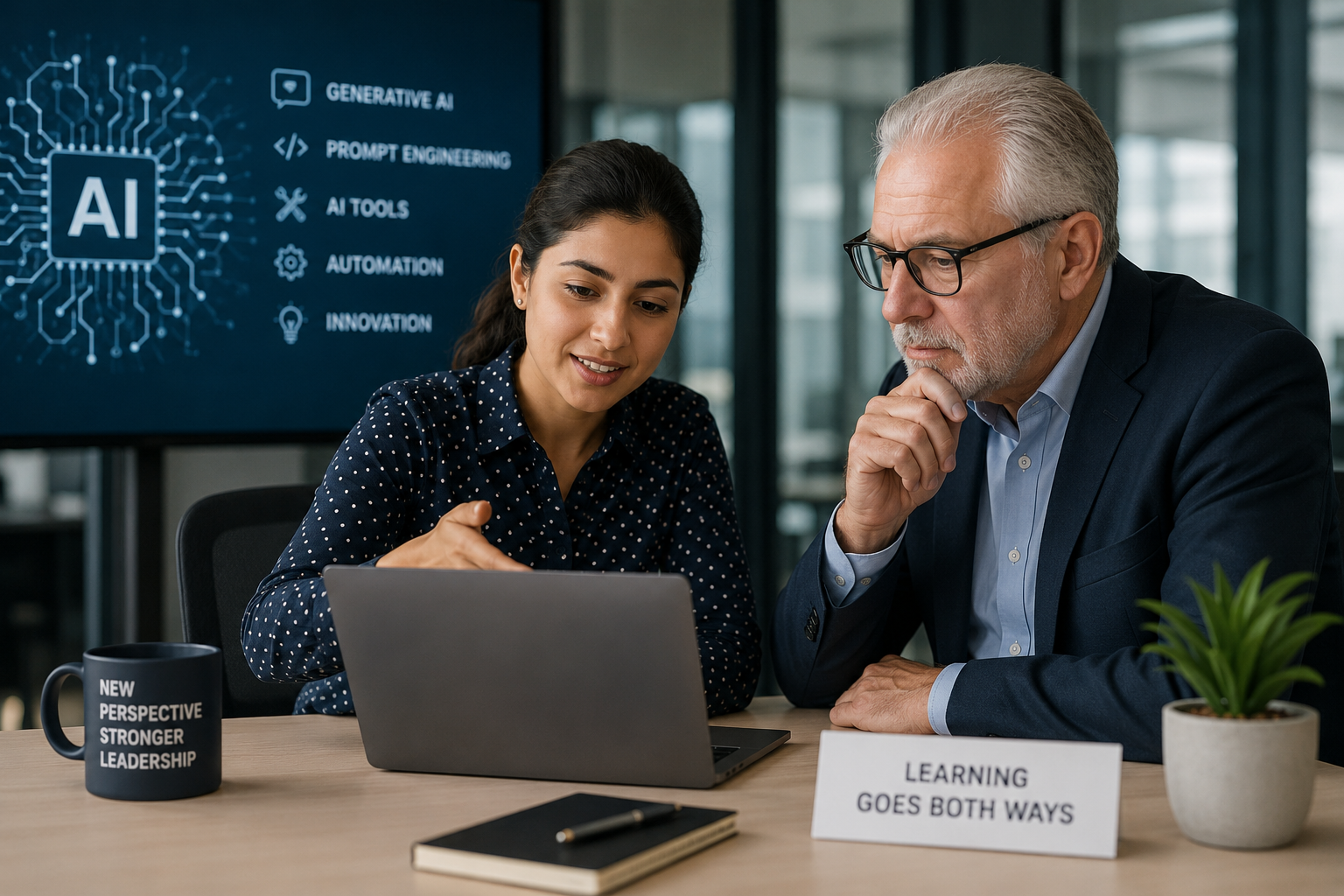
That doesn’t diminish the executive’s experience. It simply means experience and currency are different assets. And leadership increasingly requires both.
The numbers back this up. The World Economic Forum estimates 40% of core workforce skills will change by 2027. And 87% of executives already report skill gaps inside their own organisations. Separately, PwC found 75% of senior executives see a lack of digital skills in their own workforce as a major threat to the business.
Reverse mentoring creates a structured way to bring experience and currency together. Senior leaders contribute context, pattern recognition and judgment. Younger or more current practitioners contribute tools, behaviours and perspectives emerging right now. Done properly, both sides leave smarter.
Does Leadership Development Always Need a Formal Programme?
Some of the most interesting examples aren’t labelled “reverse mentoring” at all.
After stepping down as Chairman of Tata Sons, Ratan Tata began investing in a generation of Indian tech founders — many decades younger than him. He later called those investments a learning experience. A way of understanding the businesses and technologies a new generation was building.
Rajeev Suri did something similar, in his own way. He moved from two decades at Nokia into satellite company Inmarsat. There, he’s spoken about deliberately building a team more current than himself — in every technical respect the new industry demanded.

And Otis D’Souza, a 64-year-old professional, joined a Mumbai startup as an intern this year. Not as an advisor trading on decades of experience. Just at a desk, learning the pace and tools of a business run by people a third his age.
The mechanism is remarkably similar. Put yourself deliberately in rooms where you are not the most current expert. That may be the more useful definition of reverse mentoring. Because the objective isn’t to make senior leaders junior again. It is to prevent seniority from becoming insulation.
What Do Organisations Gain From Reverse Mentoring?
There are obvious benefits:
- Leaders get direct exposure to emerging technology and market behaviour — not a version filtered through several management layers
- Junior employees gain access to senior decision-makers and see their knowledge taken seriously
- Cross-generational relationships improve
- Organisations build a faster feedback loop between where change happens and where decisions get made
But perhaps the biggest benefit is cultural. When a senior leader says, “You know more about this than I do — teach me,” it sends a powerful signal. It shows the whole organisation what learning is supposed to look like.
Why Shouldn’t Leadership Development Stop at Leadership?

This is ultimately the larger point.
Leadership development is often treated as learning to lead people better — communication, influence, coaching, strategic thinking. Those capabilities matter. But senior leaders also need to keep developing the technical, functional and market knowledge behind their decisions.
That could happen through reverse mentoring. It could happen through executive coaching, practitioner interactions, industry immersion, peer learning or expert-led programmes. The format matters less than the habit.
Because when skills can lose relevance within a few years, the question for leaders is no longer: “Have I been trained for this role?” It is: “What mechanism do I have to keep learning while I’m in it?”
That is also the gap Huksa is designed to address. Rather than treating learning as a catalogue of one-off programmes, Huksa connects leaders with practitioners currently working in the domains they need to understand. Across technical, functional and leadership capabilities. Because sometimes the person who can teach you the most isn’t above you on the org chart. Sometimes they aren’t even inside your organisation.
Frequently Asked Questions
Are leadership development programmes worth it?
They’re worth it when they function as a recurring habit, not a one-off event. A single completed programme rarely survives a 2.5-year skill half-life. The value comes from treating leadership development as ongoing — not from any individual course.
What is an example of reverse mentoring in the workplace?
A common example: pairing a senior executive with a junior employee to learn a specific digital tool or platform. Something the executive doesn’t use directly. GE’s original programme and Estée Lauder’s ongoing one are both built this way — narrow topic, direct relationship, recurring sessions.
How do you implement reverse mentoring?
Successful programmes start narrow. One specific skill, a defined time commitment, and a senior leader willing to ask the questions. Estée Lauder and GE both scaled from small pilot cohorts rather than launching org-wide on day one.
How can a reverse mentoring relationship stay reciprocal?
The senior leader typically offers career guidance, context, or sponsorship in return. It works best when both sides are learning something — not when it’s framed as one-directional teaching.